Why Did I Vibe Code a Platform to Fight Vibe Directing?
OpenArt Director can turn a conversation into a production. I think that’s incredible. It also forced me to confront the irony at the heart of Atlas Observe.
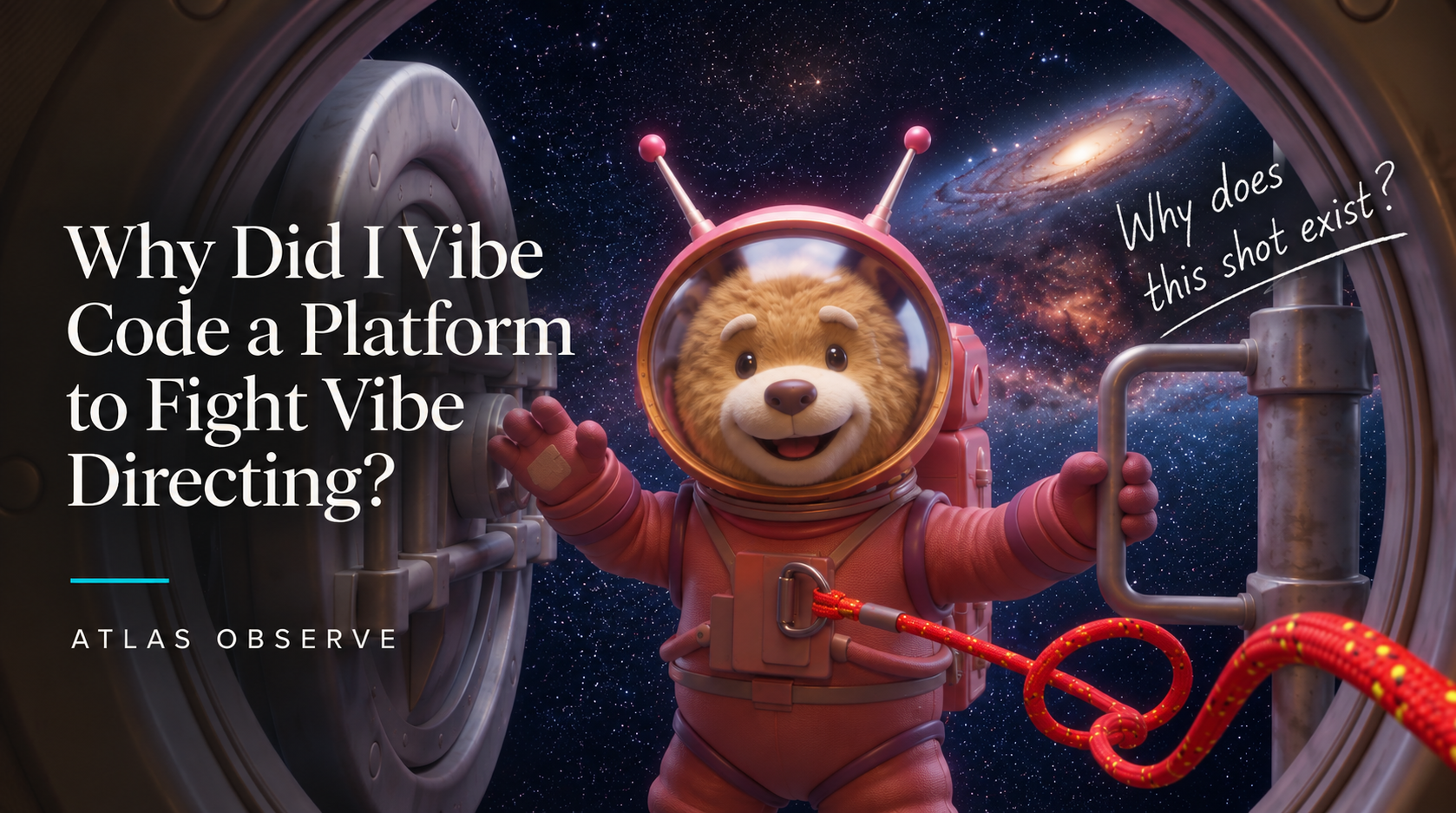
Hero image from the Cosmic Cubs pilot episode. Cosmic Cubs created by Ann Kirsten Kennis.
There’s an irony at the center of Atlas Observe that I probably need to acknowledge.
I vibe coded it.
I used AI to help me build a Creative Director platform partly because I was becoming concerned about what AI automation might do to creative direction.
Then I saw OpenArt Director.
OpenArt Director is genuinely cool.
OpenArt calls its approach “vibe directing.” You describe the idea, characters, scenes, mood and changes through conversation, and Director can build a coherent multi-scene video. OpenArt says Director can produce films up to five minutes while maintaining characters, environments, voices and visual consistency.
That is remarkable.
OpenArt is also explicit about the goal: reduce the equipment, crew, software knowledge and technical friction between someone with a story and a finished film.
I want that idea to succeed.
But watching these tools become easier made me ask a more uncomfortable question:
What, exactly, am I fighting?
The answer is: I’m not fighting AI.
I’m fighting the idea that execution and authorship are the same thing.
Making the shot is not the same as knowing why it exists.
OpenArt can increasingly help a creator establish a character, build a scene, choose a shot and refine the result through conversation.
That solves an enormous execution problem.
But filmmaking still asks another set of questions.
Why does the camera move here?
What does the character want?
Why was one performance approved and another rejected?
What did we establish earlier that has to pay off later?
What are we actually trying to say?
A beautiful shot can be generated in seconds and still have no reason to be in the film.
 Boringly simple.
Extremely serious about creative authorship.
Boringly simple.
Extremely serious about creative authorship.
This is why Atlas Observe is getting simpler.
I don’t want Atlas Observe competing with OpenArt, Adobe, Google, Runway or the next generation engine.
Let them make generation extraordinary.
Atlas Observe has a quieter job.
Purpose: Why are we making this?
Intent: What are we trying to communicate or make someone feel?
Decision: What did the filmmaker choose — and why?
Then Atlas remembers.
Accessibility is part of what makes this exciting.
There is something genuinely important happening as filmmaking becomes easier to access.
A creator may no longer need an expensive camera package, a large crew, a soundstage or a substantial production budget simply to explore an idea. For some filmmakers with disabilities, new ways of creating can also reduce physical, sensory, communication or logistical barriers that traditional production environments may present.
That doesn’t make the work automatically meaningful.
It gives more people the opportunity to make meaningful work.
And that distinction matters.
The contradiction turned out to be the point.
AI helped me build Atlas Observe.
AI will help filmmakers create things that would have been impossible for them to produce before.
I don’t see a contradiction in embracing that anymore.
The technology can make execution dramatically easier without taking responsibility for the filmmaker’s intention.
I hope OpenArt Director becomes extraordinarily good at executing the shot in my head.
I don’t need Atlas Observe to compete with that.
I need Atlas to remember why I wanted the shot in the first place.
The tools can execute.
The filmmaker still authors.
That is the part I’m interested in protecting.