Automation vs. Authorship
Vibe directing isn’t exactly filmmaking.
There’s a difference between a comedian who walks onstage and riffs with the audience and a comedian who has written a great hour.
Both can be hilarious. Both require creativity. But the written hour is building toward something.
A joke in the first ten minutes comes back forty minutes later. A seemingly meaningless detail becomes a callback. One story sets up another. The comedian knows what the audience remembers, what they expect, and exactly when to deliver the payoff.
That’s authorship.
Vibe directing can riff.
“Vibe directing” is a genuinely neat idea. Sit down with an AI and have a conversation: give me a close-up. Make her more frightened. Change the location. Move the camera. Try another version.
And increasingly, the AI can do it.
That is an extraordinary development for filmmakers. Production labor that once required enormous crews, budgets, equipment, and time can increasingly happen through a conversation.
But there’s a difference between generating the next interesting thing and building toward something.
Filmmaking has to remember the setup.
What does the character want? What happened to them three scenes ago? What do they know that the audience doesn’t? Why is the camera still here when it moved in the previous scene? Why did we choose this performance instead of the twenty other convincing performances the model generated?
And when something established in Scene 4 finally pays off in Scene 37, who remembered it?
That’s where filmmaking becomes more than generating shots.
Consistency isn’t just keeping a character’s face or wardrobe the same. It’s maintaining character, motivation, performance, emotion, timing, visual language, and creative intent across the entire production.
On a traditional set, an entire human system helps maintain that memory: directors, actors, cinematographers, editors, script supervisors, and department heads. AI doesn’t make that responsibility disappear.
Vibe directing can riff.
Filmmaking has to remember the setup.
 Boringly simple.
Ridiculously serious about authorship and control.
Boringly simple.
Ridiculously serious about authorship and control.
Automation makes authorship more important.
Generative filmmaking may soon give us something filmmakers have never really had: nearly infinite takes.
Don’t like it? Generate another. Change the lens. Change the performance. Change the lighting. Try another renderer. Make twenty versions.
When almost anything becomes possible, the filmmaker’s most important responsibility may no longer be figuring out how to make the shot. It may be deciding which shot belongs in the film — and why.
That is authorship.
The filmmaker still carries the intention.
I don’t think vibe directing is bad. Quite the opposite. It’s fun, useful, and we’re going to see remarkable work created this way.
But improvisation and sustained creative intention are different things.
That’s also the question that led me to build Atlas Observe: as filmmaking becomes distributed across AI models and tools, where does the production remember what the filmmaker decided — what was approved, what was rejected, what a character wants, what must remain consistent, and what all of this is building toward?
Why Buster Keaton?
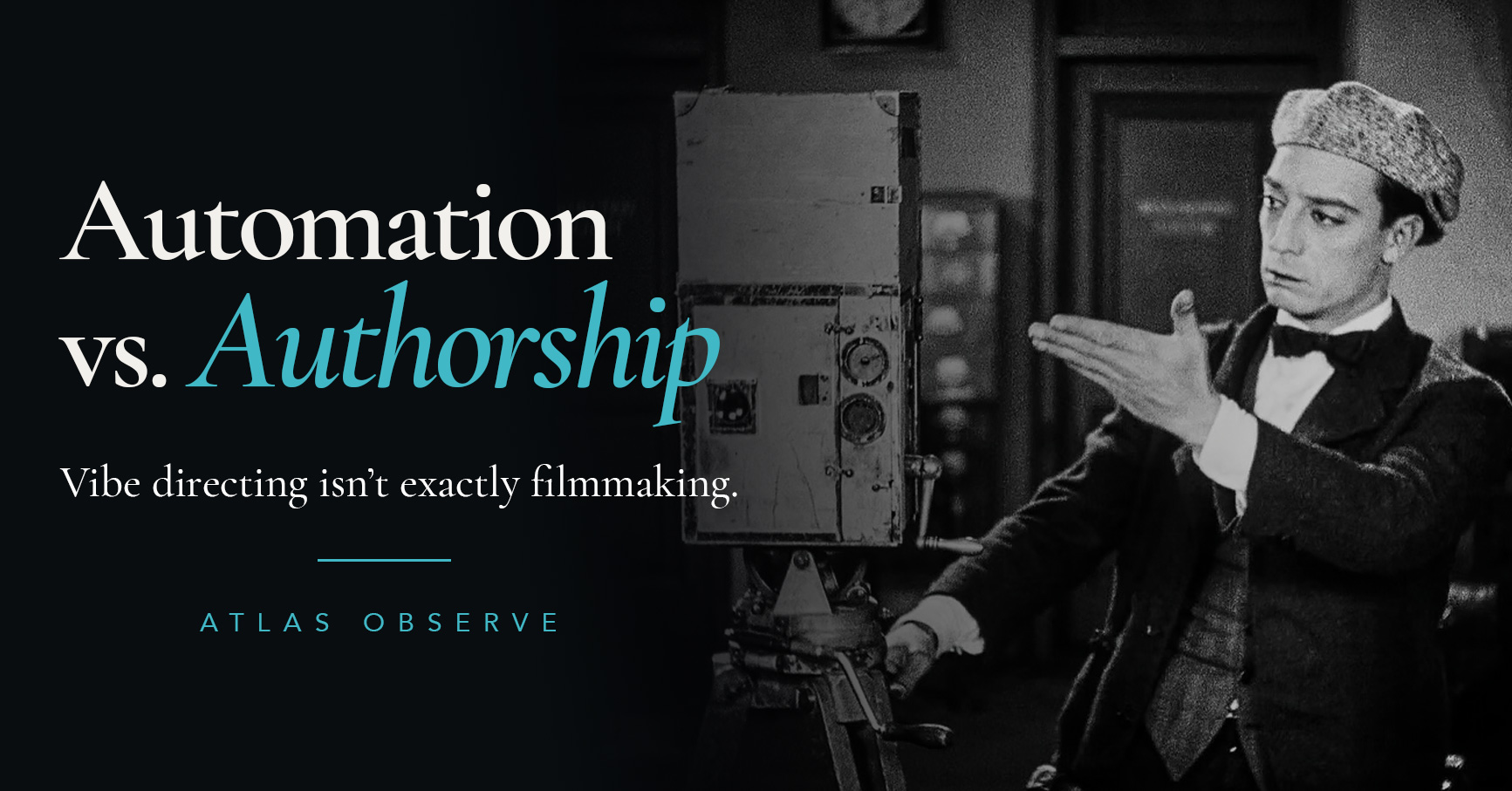
There’s a reason Buster Keaton appears at the top of this article — and why the final image for this piece comes from The Cameraman (1928).
Keaton was a pioneer of early filmmaking and an extraordinarily hands-on filmmaker. He didn’t simply perform in front of the camera. He helped shape the stories, directed and conceived sequences, developed elaborate visual gags and special effects, and became famous for performing extraordinarily demanding physical stunts himself. He understood filmmaking from both sides of the camera — as an idea to be authored and a physical problem to be solved.
And that is why he belongs here. In The Cameraman, Keaton is literally working with the filmmaking apparatus of his era: carrying it, operating it, solving problems with it, and trying to make the shot. The machine is essential. But the machine is not the author.
Being hands-on does not mean rejecting new technology or insisting that every task must be difficult. Keaton himself was constantly finding ingenious ways to use the technology of his time to accomplish things audiences had never seen before.
Authorship is not about doing everything manually. It is about remaining responsible for the creative intention.
That is the balance I’m interested in with AI.
Let the machine remove friction. Let it render the impossible. Let it automate work that once consumed days, weeks, or entire departments.
But don’t automate away the filmmaker.
The filmmaker still chooses the setup.
The filmmaker still recognizes the performance.
The filmmaker still decides when to cut, when to hold, when something is finished — and when something impressive simply doesn’t belong.
Keaton used the tools available to him to expand what a filmmaker could do. That image — a filmmaker beside the technology, still responsible for the intention — is exactly the balance I want Atlas Observe to protect.
AI should do the same.
The machine can generate the video.
The filmmaker authors the film.
Want to see what that looks like in practice? Atlas Observe is a free prototype for preserving creative intent, continuity, approvals, and production memory across AI-assisted filmmaking.